
Case Study · Controls & Finance Transformation
Supplier Document & Payment Control System
A workflow-controlled internal system that strengthened duplicate-payment prevention and improved document visibility across the procure-to-pay cycle.
Executive summary
Supplier payments depend on a chain of supporting documents and approval steps — purchase orders, invoices, delivery confirmation and review sign-off — being complete and consistent before a payment is made. This system gives finance and procurement teams shared visibility over that chain and enforces payment readiness before a record is marked complete.
Business challenge
Tracking supplier documentation and payment readiness across purchasing, invoicing and payment stages is difficult to do reliably without a shared system of record. Gaps in document visibility and inconsistent status tracking increase the risk of control weaknesses in the procure-to-pay cycle, including the risk of duplicate payment requests progressing without being identified.
Stakeholders and users
- Finance staff processing supplier payments and reconciling supporting documentation.
- Procurement staff managing purchase orders and supplier records.
- Finance management, who need oversight of payment-readiness status and control exceptions.
Approach
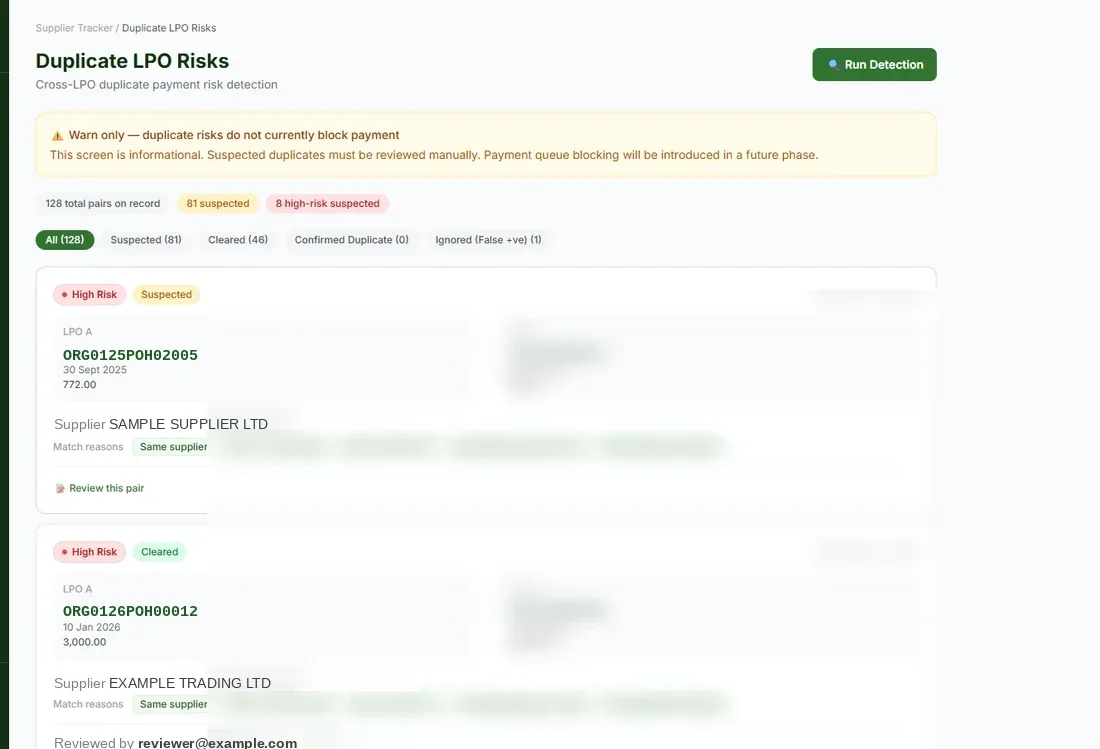
The system centres on a status-driven workflow: each supplier payment record moves through defined stages, and a compliance gate prevents progression to "Ready for Payment" until required documents and review steps are complete. Duplicate-payment risk is addressed at the system level through database constraints and structured duplicate-detection checks, rather than relying solely on manual cross-checking.
Workflow
- Purchase orders, invoices and supporting documents are logged and linked to a specific supplier record.
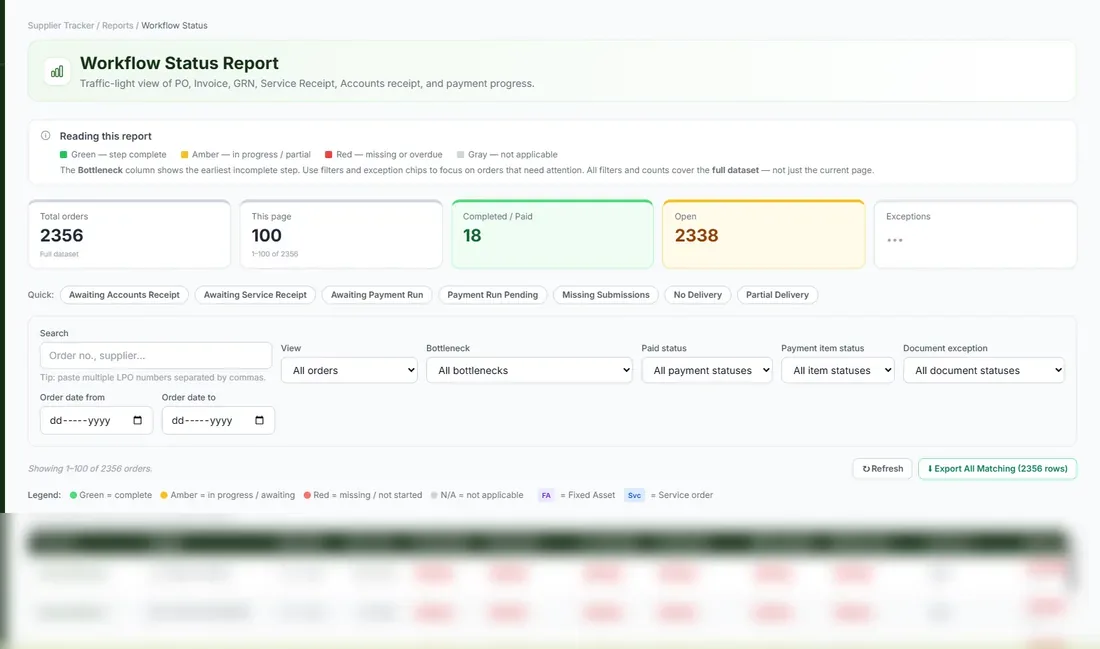
- Each record carries a status reflecting where it stands in the document and review chain.
- The compliance gate blocks a record from reaching "Ready for Payment" status until required documents and reviews are confirmed complete.
- Records flagged with potential duplication risk are surfaced for review before payment.
Controls
- SQL-level constraints support structural prevention of duplicate entries at the data layer.
- The workflow gate enforces document completeness before payment readiness is reached.
- Row-Level Security restricts visibility of supplier and payment data by role.
Analytics and reporting
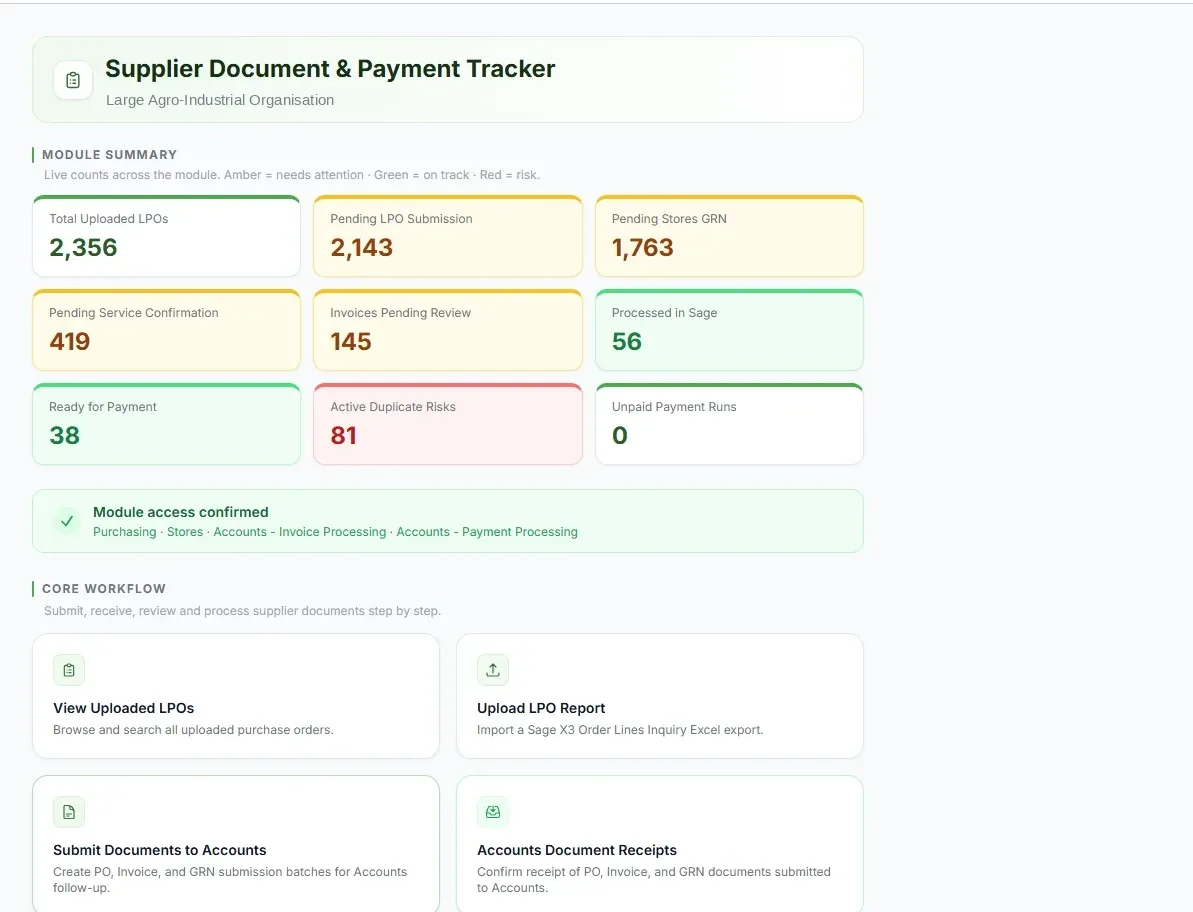
A command-centre view gives finance and procurement leadership a consolidated picture of supplier records by status, alongside dedicated views for workflow status tracking and duplicate-payment risk flags — supporting procure-to-pay monitoring as an ongoing activity rather than a periodic manual review.
System views
Technology used
Outcomes
- Strengthened duplicate-payment prevention through system-level checks and constraints.
- Improved document visibility across the purchasing, invoicing and payment chain.
- Strengthened preventive controls through a compliance gate ahead of payment readiness.
- Supported procure-to-pay monitoring as a continuous, system-backed activity for finance and procurement teams.
Lessons learned
Building duplicate-detection logic directly into the data layer, rather than relying only on workflow steps, made the control materially more reliable. Getting the status model right early — so that "Ready for Payment" genuinely meant every prior requirement was satisfied — was the key design decision the rest of the system depended on.
Confidentiality note: the employer name has been replaced with "a large agro-industrial organisation," internal reference codes have been replaced with generic ORG-prefixed examples, and supplier names shown are synthetic. No real supplier, employee or reviewer information appears in this case study.