
Case Study · Operations & Controls
Fuel Consumption & Equipment Performance Monitoring System
An internal monitoring system giving management asset-specific visibility over fuel consumption and equipment performance across a large mixed fleet — from passenger vehicles and trucks to tractors and heavy equipment.
Executive summary
The organisation operates a large fleet — over 100 vehicles and pieces of heavy equipment, ranging from passenger vehicles and trucks to tractors used in field operations. Fuel is a significant recurring operating cost, and consumption patterns vary widely by asset type, so a single consumption benchmark cannot meaningfully evaluate performance. This system was built to give management asset-specific, operator-level visibility into fuel consumption, with exception reporting to flag consumption that falls outside expected ranges.
Business challenge
Fuel usage across a mixed fleet of this size is difficult to monitor manually and even harder to benchmark meaningfully. Vehicles and trucks are best measured in litres per 100 kilometres, while tractors and other heavy equipment operate on an hours basis and are better measured in litres per operating hour. Without a system distinguishing between these measures and tracking them by individual asset and operator, abnormal consumption — whether from mechanical issues, driving behaviour, or data-entry error — was difficult to identify early.
Stakeholders and users
- Finance and management, who require consolidated visibility into fuel cost and consumption trends.
- Transport and fleet supervisors, who monitor day-to-day consumption by vehicle and operator.
- Drivers and equipment operators, whose entries and performance are reflected in the system.
Approach
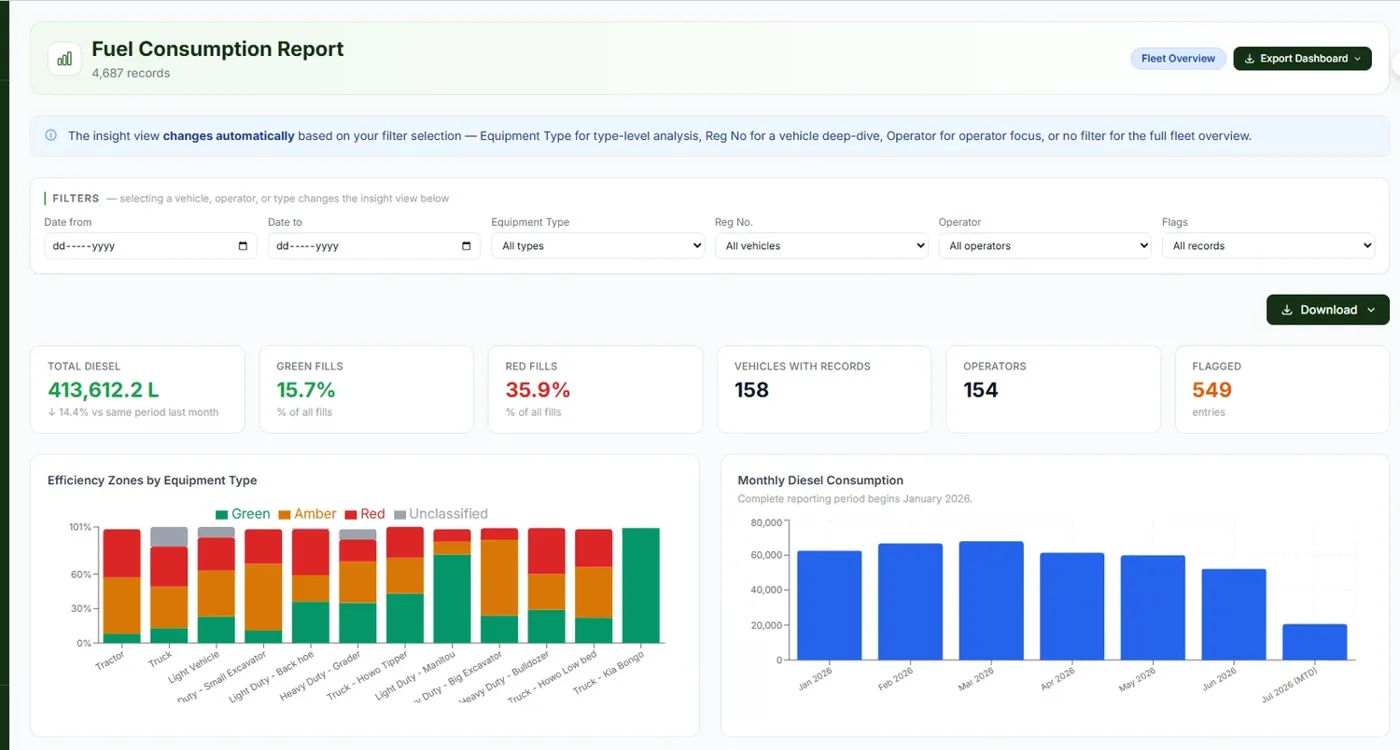
The system was designed around the practical reality that "normal" fuel consumption means different things for different asset classes. Two parallel benchmarking measures were built in from the start: litres per 100 kilometres for vehicles and trucks, and litres per operating hour for tractors and heavy equipment. Each asset carries its own benchmark range, informed by its type and typical duty cycle, rather than being measured against a single fleet-wide average.
Workflow
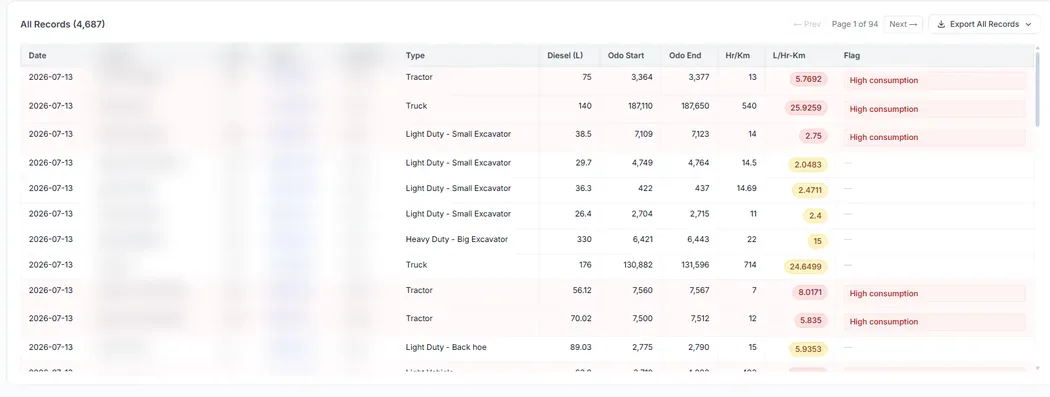
- Fuel dispensed to a vehicle or piece of equipment is logged against the specific asset and the operator on duty.
- Odometer or engine-hour readings are captured alongside each fuel entry to support the correct per-distance or per-hour calculation.
- The system calculates rolling consumption metrics per asset and compares them against the asset's benchmark range.
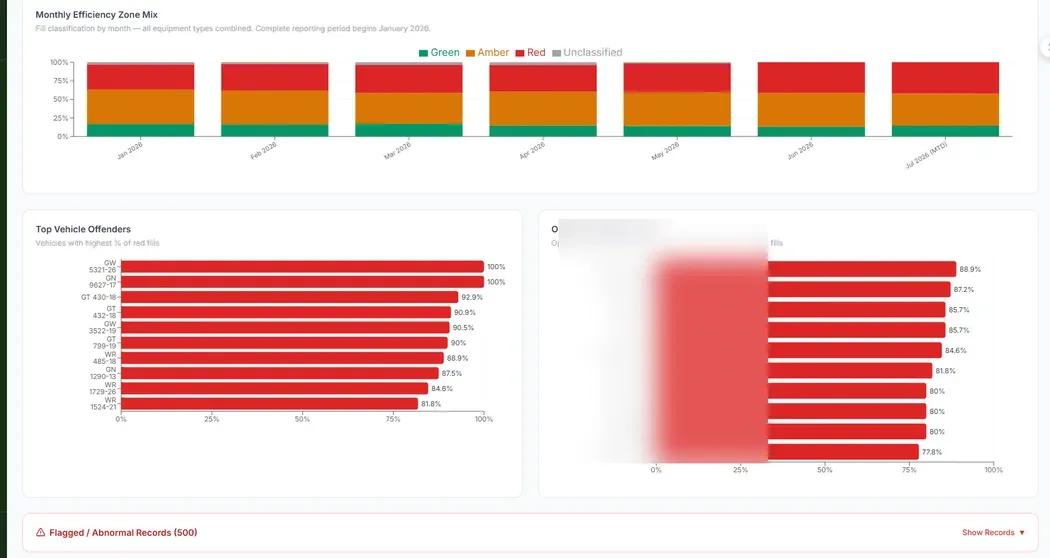
- Entries and trends outside the expected range are surfaced for supervisor review rather than silently accepted.
Controls and data quality
- Validation rules on entry help catch implausible readings (for example, a distance or hour reading inconsistent with the previous entry) before they distort reporting.
- Operator-level attribution supports accountability for consumption patterns tied to driving or equipment-handling behaviour.
- Row-Level Security restricts each user to the fleet data relevant to their role.
Analytics and reporting
Management dashboards summarise consumption trends by asset class, individual asset, and operator, alongside an exception view highlighting assets currently outside their benchmark range. This gives fleet supervisors and finance a shared, current view of where fuel cost is concentrated and where it may warrant investigation.
System views
Technology used
Outcomes
- Improved operational visibility into fuel consumption across a fleet of 100+ vehicles and equipment.
- Asset-appropriate benchmarking (distance-based and hours-based) instead of a single fleet-wide standard.
- Strengthened operator-level accountability for consumption patterns.
- Earlier visibility of abnormal consumption through exception reporting, supporting timelier investigation.
Lessons learned
Benchmarking a mixed fleet only works if the metric matches how the asset is actually used — a single consumption ratio applied fleet-wide would have produced misleading exceptions. Getting the odometer/hour-reading data quality right at the point of entry proved as important as the analytics built on top of it.
Confidentiality note: the employer name has been replaced with "a large agro-industrial organisation" throughout this case study, and all screenshots reflect anonymised, non-sensitive data views.